Start With the Site, Not the Product Label
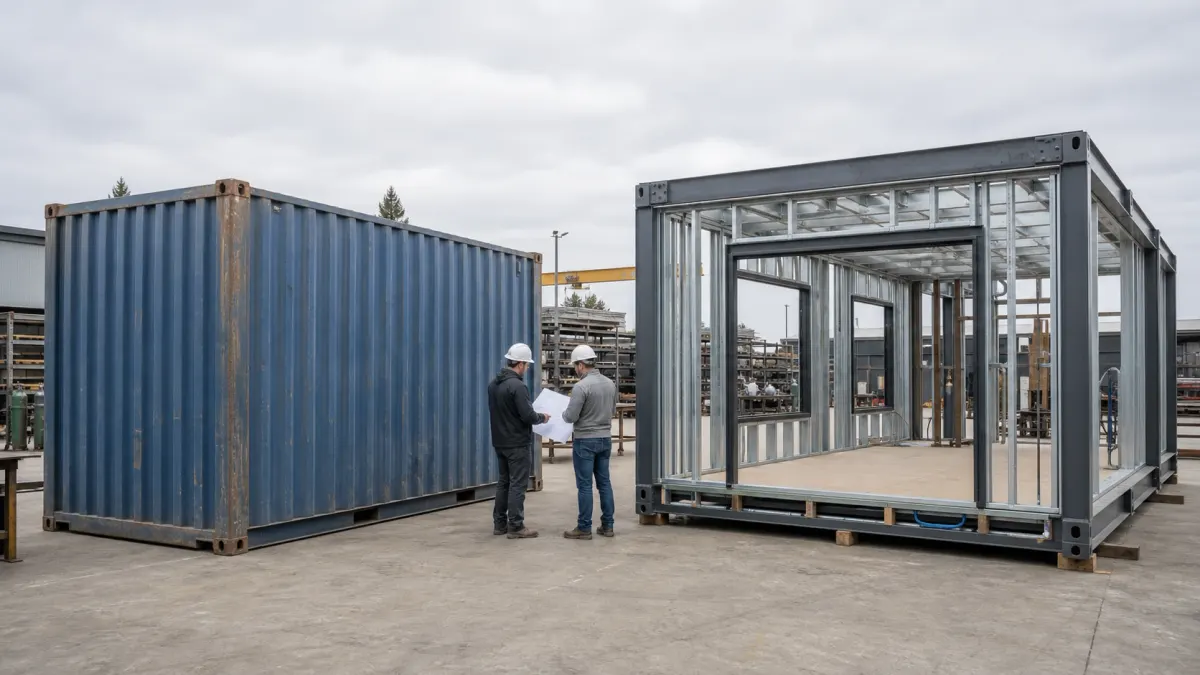
A deployment format describes how a building travels and is opened at its destination. It does not, by itself, establish quality, durability, suitability, or readiness for use. Two products sold under the same label may arrive in different transport states and require different lifting arrangements. Products with different names may use similar hinges, panels, connections, and site procedures. The buyer should compare the complete sequence from factory dispatch to an occupiable building. Begin with the receiving site. Record the destination, access road, gate dimensions, turning and reversing space, overhead obstructions, unloading area, ground conditions, available lifting equipment, local labour capability, weather exposure, and the date on which the building is expected to become usable. Note the planned number of units and whether they will arrive together or in separate consignments. These details describe the deployment problem more accurately than a catalogue image or a short product description. This is different from choosing between a converted freight container and a purpose-built building module. That comparison concerns building logic and design intent.
Define the Four Deployment Formats
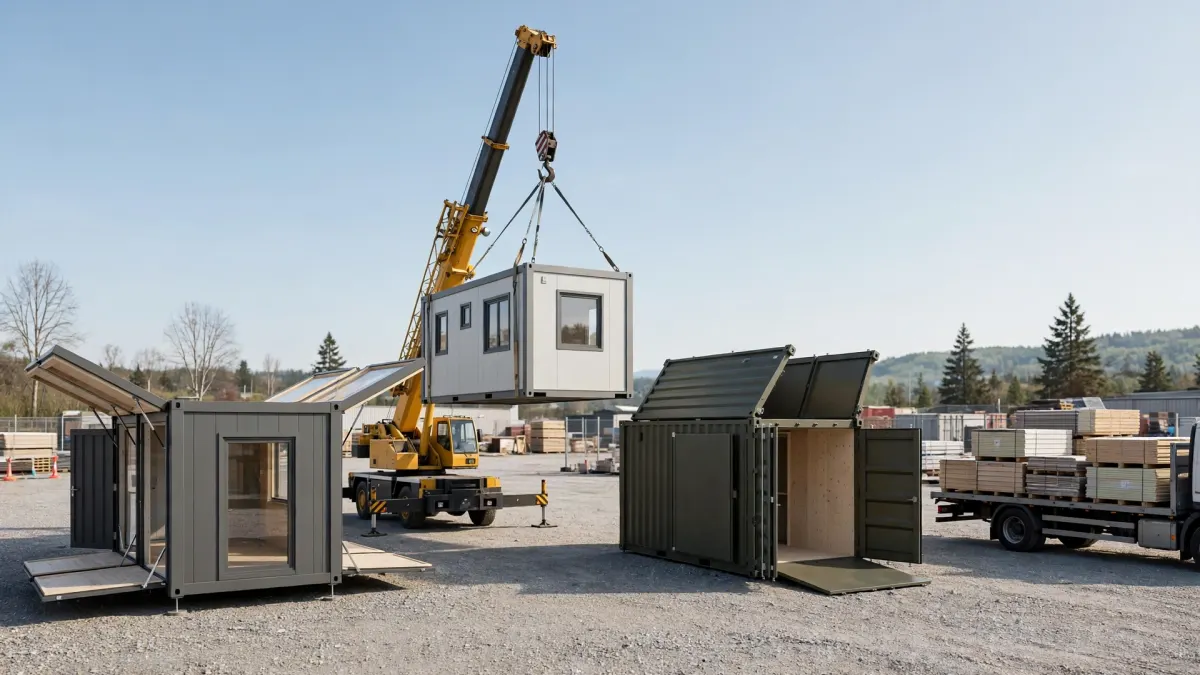
The words expandable, detachable, folding, and flat-pack are not used consistently across the modular-building market. They are useful commercial descriptions, but they are not a universal technical classification. One supplier may call a hinged side-wing product “folding”; another may describe a similar arrangement as “expandable.” The label alone cannot tell a buyer how many packages will arrive, what equipment is needed, or which work remains at the destination. For this comparison, an expandable unit is a largely integrated building that travels in a reduced configuration and opens at the site. Floor, wall, or roof elements may move on hinges or other mechanisms into their operating positions. The important questions concern the opening sequence, temporary support, locking, sealing, and inspection of moving parts and interfaces. Ask whether the unit is opened as one coordinated operation or through several separately controlled movements. A folding format is one in which major building elements are folded for transport and unfolded during deployment. It can overlap with an expandable format.
Map the Transport Envelope Before Comparing Formats
The transport envelope is the physical state that the carrier actually receives. It includes the unit or package, protective wrapping, attached projections, loose accessories, lifting attachments if shipped with the load, and the proposed vehicle or container arrangement. The expanded floor area is not a transport dimension. A flat-pack may occupy less volume than a complete cabin while requiring more packages, more handling events, and a different loading and receiving plan. Ask each supplier for a revision-controlled packing schedule. It should identify the number of packages, external dimensions, gross and net weights where available, centre-of-gravity information where relevant, lifting points, fragile zones, separately shipped items, and the configuration assumed in the transport proposal. Require the supplier to state what each weight includes. Do not assume that a drawing or packing list for one model or revision describes another. Package labels should correspond to the parts schedule and the installation sequence, not rely on informal descriptions written for a single shipment. The route matters as much as the factory gate.
Test the Actual Route and Receiving Sequence
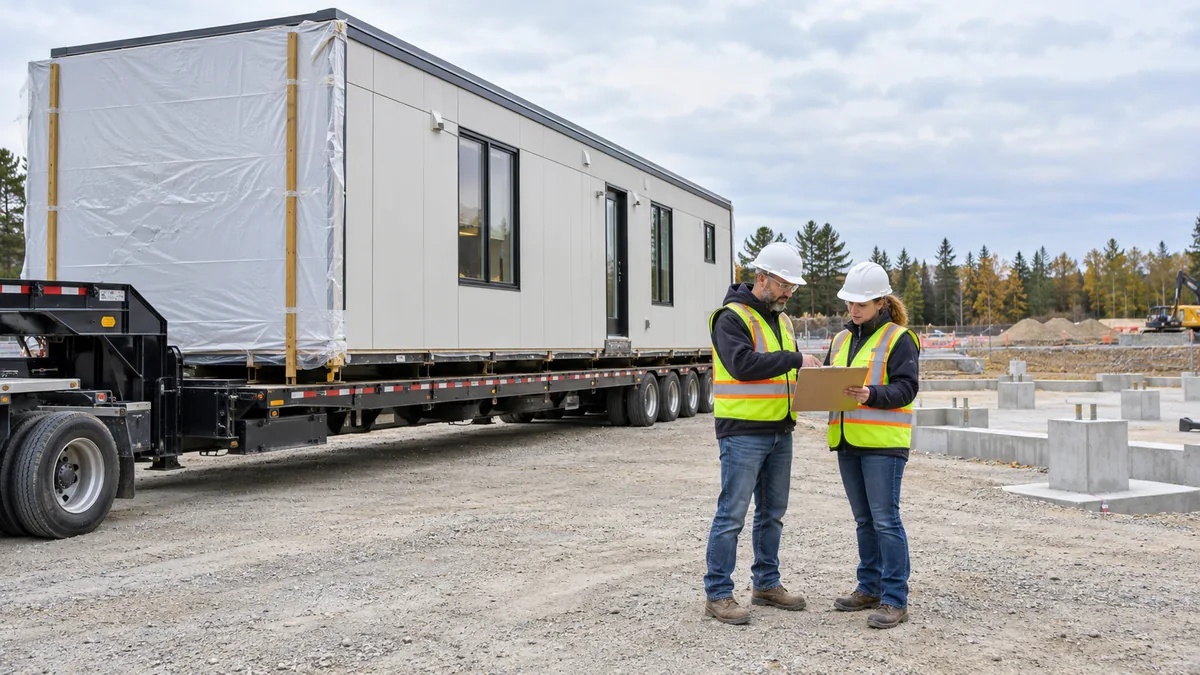
A route review should follow the shipment from collection to the exact place where it will be unloaded. “Delivery to site” is not precise enough if a truck can enter the property but cannot reach the prepared pad. Ask the carrier to review the actual load configuration and intended vehicle, then list assumptions that remain unconfirmed. For an expandable or folding unit, confirm that the vehicle can position the unit with enough clear space for the opening movement. A unit may pass through the gate in its folded state yet have no room to extend once positioned. Check fences, trees, slopes, neighbouring buildings, drainage channels, temporary works, and public access areas. Consider whether the vehicle must leave before the unit can be opened and whether the opening sequence blocks another delivery. For detachable and flat-pack formats, account for every package, not only the largest one. Identify unloading order, temporary storage, weather protection, package labels, handling equipment, and the distance between storage and assembly.
Treat Crane Access as a Site Constraint
A crane is not a generic line item that can be added after the format has been selected. A lift depends on documented load weight and geometry, centre of gravity, intended lifting points, rigging arrangement, crane position, working radius, ground support, overhead clearance, nearby structures, and the path through which the suspended load will travel. A qualified local lifting team must review these details using the actual unit and site information. An integrated expandable unit may arrive as a single lift, but that does not make the lift simple. The centre of gravity in the transport configuration may differ from the opened configuration. Lifting points must be intended for the actual lifting state, and the method must account for loose or moving elements. Never infer lifting suitability from a photograph or from the fact that a product is moved by crane inside a factory. Ask whether transport restraints remain in place during lifting and what must be removed or secured before the lift begins.
Count the Work That Happens After Arrival
The first useful comparison after unloading is a task list. For each format, identify who removes transport restraints, sorts parts, positions elements, installs temporary supports, aligns joints, connects assemblies, applies seals, completes weatherproofing, installs doors or accessories, connects services, and checks the finished work. Record which tasks require qualified trades, specialist tools, access equipment, supervision, or inspection. An expandable unit may reduce the number of separate components assembled on site, but its opening sequence can require careful coordination. The team may need to control movement, keep people clear of pinch points, position supports, secure locks, and verify that seals and connections are correctly engaged. Supplier instructions should identify the crew, tools, and checks assumed by the proposed installation method. Ask how the team confirms that every moving section has reached its intended position before finishing trims or connecting services. A detachable unit shifts attention to interfaces between sections. Alignment, fastener access, joint sealing, roof and floor transitions, and service connections become central.
Compare Opening Speed With Readiness, Not Marketing Time
“Opening time” can refer to several different milestones: unfolding a unit, completing mechanical connections, making the shell weather-resistant, connecting utilities, completing local inspections, or welcoming the first guest. These milestones are not interchangeable. A short mechanical opening sequence does not establish that a building is ready for occupancy. Ask suppliers to define the start and finish points for every time estimate. Does the clock begin when the truck arrives, when the unit is unloaded, or after foundations and lifting equipment are ready? Does the estimate include package sorting, weather delays, sealing, local electrical and plumbing work, checks, cleaning, and handover? What crew size, skill level, tools, and site conditions are assumed? Without these details, advertised durations cannot be compared fairly. For an expandable or folding format, separate structural movement from the checks that follow. A unit may reach its open geometry before locks, joints, weather seals, doors, and service interfaces have been checked. For detachable formats, record the work involved in joining and sealing each interface.
Match Each Format to Site Conditions
Expandable formats may be worth shortlisting when the site can receive an integrated unit, the opening area is clear, and the operator wants to limit the number of separate components assembled on site. They may be less attractive where the unit cannot be positioned with the necessary clearance, where the opening mechanism needs support that cannot be provided, or where the folded transport envelope does not fit the receiving route. Folding formats deserve close review when the folding sequence is repeatable and the project can protect moving parts and connections during deployment. Ask whether the same crew can repeat the process across multiple units without losing control of alignment, sealing, or documentation. As the number of units increases, consistent work instructions and quality records become more important. The buyer should also understand how the supplier expects folded components to be inspected after repeated handling or relocation. Detachable formats may fit sites where large integrated loads are difficult to deliver but the destination has the space, equipment, and trained labour to join assemblies.
Check Utilities, Foundations, and Interfaces
The deployment format does not settle the building's relationship with the site. Before choosing, map the interfaces between the unit and its foundations, anchors, stairs, decks, drainage, electrical supply, water, wastewater, communications, and external equipment. Show which interfaces are factory-prepared, which items are supplied loose, and which must be designed or completed locally. A unit that opens quickly can still be unusable if foundation positions are not ready, service entries do not align, drainage cannot be connected, or the site lacks the required utility capacity. Flat-pack assembly may also leave later coordination work: service penetrations, wet-area connections, ventilation routes, and external junctions need to be completed in the correct sequence. Include access for future maintenance, not just the initial connection. Request interface drawings and a responsibility schedule. Each item should have an owner, required input, evidence record, and completion point. Distinguish preliminary information from approved project documents. If the supplier provides suggested foundation or anchoring information, it must be reviewed against site conditions by the destination-side engineer or another qualified local professional.
Build a Like-for-Like Format Evaluation
Use one evaluation sheet for every shortlisted format. Keep project assumptions constant and ask each supplier the same questions. The aim is not to create a universal score that hides trade-offs; it is to expose which format shifts work, risk, space, equipment, and coordination to the destination. The sheet can include transport state and package count; documented dimensions and weights; carrier route status; unloading method; crane or forklift dependency; required clear space; temporary storage needs; number and type of site connections; crew composition; specialist tools; weather exposure during assembly; stated time milestones; utility interfaces; local inspections; and documents delivered with the unit. Add a column for the evidence source and the revision date so that old assumptions are not mistaken for current facts. Use separate status labels such as confirmed by drawing, supplier-stated, carrier-reviewed, locally assessed, pending, and not applicable. Do not treat a supplier estimate as a carrier confirmation or a preliminary site sketch as an engineering assessment. Where information is missing, record the question and the person responsible for resolving it.
Record Risks, Unknowns, and Change Triggers
Every format comparison contains assumptions. A disciplined buyer makes them visible. Record uncertainties about route permissions, package weights, lifting points, ground-bearing conditions, crane availability, storage, weather, labour, utility capacity, and local approval requirements. For each item, identify who can answer it and what evidence will close it. Set change triggers before the order is frozen. Examples include a revised transport configuration, a changed package count, a different vehicle, an altered gate or road, a moved foundation, a different crane position, or a revised unit layout. Any change affecting the load, lifting method, opening movement, or site interface should be reviewed by the parties responsible for that part of the work. A change to one drawing may also affect packaging, delivery order, or the installation method. A risk register is not a substitute for technical review. A note saying “crane access to be checked” does not prove that a lift is feasible. A statement that “local assembly is straightforward” does not identify the trades or tools required.
Make the Selection and Freeze the Handover Package
Choose the format only after testing four questions: can the shipment reach the site in its actual transport state; can it be unloaded and positioned safely; can the destination team complete opening or assembly with available labour and equipment; and can the resulting building connect to the site and pass the required local review? If an answer depends on an unresolved assumption, record the selection as conditional. Before production or dispatch, freeze the model, configuration, transport state, package list, drawings, lifting information, opening sequence, interface details, and responsibility schedule under a common revision. Give the carrier, receiving contractor, lifting planner, installer, and operator the documents relevant to their tasks. A change after review should trigger an updated document and a fresh check by the affected party. Make sure obsolete packing lists and drawings are withdrawn from the site team. At handover, keep factory supply acceptance separate from local installation completion and final approval. Record delivered condition, missing or damaged items, documents received, open work, and the party responsible for each remaining action.
Sources
Sources reviewed on November 13, 2026.
- IMO, ILO and UNECE, Code of Practice for Packing of Cargo Transport Units (CTU Code): https://www.imo.org/en/ourwork/safety/pages/ctu-code.aspx — non-mandatory international guidance on packing, handling, receiving, and securing cargo transport units across sea and land transport.
- Occupational Safety and Health Administration, 29 CFR 1926.1402 — Ground Conditions: https://www.osha.gov/laws-regs/regulations/standardnumber/1926/1926.1402 — US construction requirements concerning crane setup ground conditions and known subsurface hazards.
- Occupational Safety and Health Administration, 29 CFR 1926.1425 — Keeping Clear of the Load: https://www.osha.gov/laws-regs/regulations/standardnumber/1926/1926.1425 — US requirements for hoisting routes and worker exposure to suspended loads.
- U.S. General Services Administration, Pre-engineered and Prefabricated Buildings Ordering Guide: https://www.gsa.gov/buy-through-us/purchasing-programs/multiple-award-schedule/preengineered-and-prefabricated-buildings-ordering-guide — procurement guidance covering intended use, site preconditions, utilities, foundations, and installation scope.
- MK Mobile House, Modular Building Delivery: Route, Lift and Site-Readiness Checks: https://mkmobilehouse.com/blog/modular-building-delivery-route-lift-site-readiness/ — related buyer-side planning for route review, lifting responsibilities, site preparation, and dispatch decisions.
- MK Mobile House, Shipping Container or Purpose-Built Module? Compare the Building Logic Before the Price: https://mkmobilehouse.com/blog/shipping-container-vs-purpose-built-module-building-logic/ — related reading on the separate question of structural and building-system logic, not a comparison of deployment formats.