Why This Act Matters to a Modular Buyer
The 21st Century ROAD to Housing Act became Public Law 119-101 on July 11, 2026. Its Title III provisions address two different issues for factory-built housing: the federal treatment of homes built without a permanent chassis, and the way construction financing may fit modular production. These are meaningful policy changes, but they do not create a project approval route or make every factory-built product eligible for a federal housing programme.
For a buyer sourcing a home or cabin from an overseas manufacturer, the practical questions are which legal category the proposed building falls into, which federal or state framework applies, and what the destination authority requires for the actual site and use. This guide reads Sections 301 and 302 as enacted and separates their statutory directions from work HUD and the states still need to complete. Its review date is November 13, 2026. It is a procurement guide, not legal advice; destination-side building, planning and finance professionals should confirm the route before a production order is placed.
Start with the Difference Between Manufactured and Modular Homes
“Factory-built” describes where construction takes place; it does not settle the regulatory category. Manufactured homes have historically been regulated under the federal Manufactured Housing Construction and Safety Standards, commonly called the HUD Code. Conventional modular homes are generally designed and reviewed under the state and local building codes applicable where they will be installed.
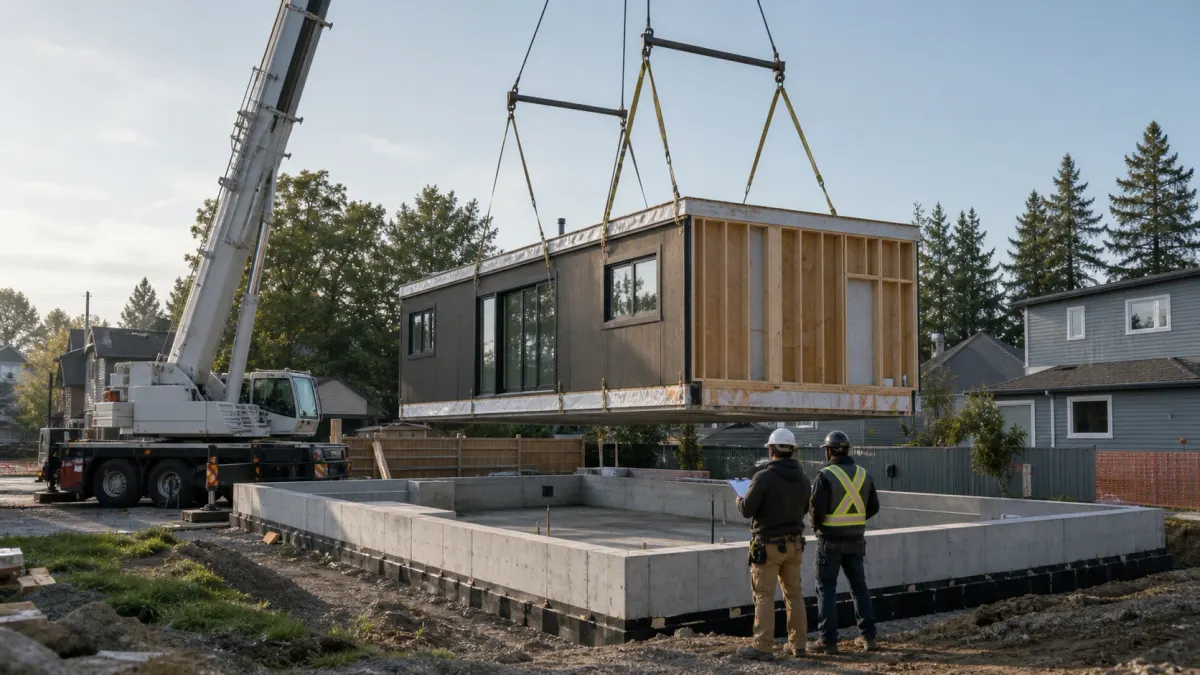
Section 302 defines a modular home as a home constructed in a factory in one or more modules, with each module meeting the applicable state and local building codes for the destination area, then transported to the site, installed on foundations and completed. The destination jurisdiction is therefore central to the modular pathway.
The amended federal definition of “manufactured home” is a separate question. A product does not become a HUD-regulated manufactured home merely because a supplier calls it modular, prefabricated, a container home or a cabin. Its physical characteristics, residential use, statutory definition and federal programme requirements matter. Buyers should ask the local design lead to document the proposed classification rather than rely on a sales label.
Section 301 Removes the Permanent-Chassis Requirement
Before the Act, the statutory definition of a manufactured home required it to be built on a permanent chassis. Section 301 changed that wording to allow a home to be built “with or without a permanent chassis.” A permanent steel chassis is therefore no longer a defining prerequisite in the federal statutory definition.
The amendment may allow qualifying factory-built residential designs without a permanent chassis to be considered within the federal manufactured-housing framework. It also gives HUD a reason to examine how such homes are transported, supported, assembled and installed.
The scope is not unlimited. The amended definition still describes a transportable structure in one or more sections, meeting the statute’s size and residential-use criteria and designed to function as a dwelling when connected to required utilities. It excludes self-propelled recreational vehicles. The Act does not say every prefabricated building, commercial site cabin, relocatable office or modular room automatically becomes a manufactured home.
For buyers, classification comes before procurement assumptions. Ask a destination-side professional to compare the proposed building and its intended use with the statutory definition and applicable regulatory route.
HUD Must Develop the Chassis-Free Standards
Changing the definition does not provide the technical rulebook for designing, producing and installing every chassis-free home. Section 301 directs HUD, in consultation with the Manufactured Housing Consensus Committee, to issue revised standards for manufactured homes built without a permanent chassis. It also requires a distinct label and data-plate treatment to distinguish these homes from homes built with a permanent chassis.
HUD’s October 7, 2026 Next Generation Manufactured Housing Action Plan confirms that implementation work is underway, while identifying further standards, research and technical input as necessary. The plan identifies updates to the construction standards in 24 CFR Part 3280 and installation standards in Part 3285. Topics include structural design, transportation, lifting, connections, foundations, anchoring and setting procedures.
The plan also identifies a possible multi-module pathway, off-chassis case studies and guidance to help existing modular and off-site manufacturers enter the HUD system. These are work areas, not proof that a particular overseas product already meets future requirements. The action plan is not a product approval, a completed code or a substitute for project review.
State Certification Is a Separate Implementation Gate
Section 301 requires states to certify to HUD that their laws and regulations treat homes without a permanent chassis in parity with manufactured homes built with one. The statute identifies areas including financing, title, insurance, manufacture, sale, taxes, transportation and installation.
The initial certification deadline is generally one year after enactment, July 11, 2027. A state whose legislature meets biennially has two years. States must also provide annual recertification, and HUD must publish and maintain a list of states current with their submissions.
The law attaches a significant consequence to a missed deadline: a state that has not submitted the required certification must, after the applicable deadline, prohibit the manufacture, installation or sale of a covered chassis-free manufactured home in that state, subject to the statute’s allocation of installation oversight. State status is therefore a procurement issue, not an administrative detail to leave until delivery.
HUD’s standards work and state certification are related but distinct. Buyers should not assume that one completes the other. Before committing to a chassis-free route, ask the destination professional to check HUD’s current list, state laws and regulations, and the local authority’s interpretation for the proposed site and use.
Section 302 Directs HUD to Review FHA Construction Financing
Section 302, the Modular Housing Production Act, addresses financing rather than the chassis definition. It directs HUD to review Federal Housing Administration construction-financing programmes for barriers to modular building methods. The review must examine regulatory and programme features that may restrict modular developers’ participation, including construction draw schedules. HUD must also identify administrative measures available under Section 525 of the National Housing Act that could facilitate programme use.
HUD must publish a report describing the review and recommended policy or programme changes no later than July 11, 2027. Within 120 days after publishing it, HUD must initiate rulemaking to examine an alternative draw schedule for construction-financing loans to modular and manufactured-home developers. Interested stakeholders must be able to comment. After the comment period, HUD must issue a final rule or explain why it will not become final.
A draw schedule determines when loan funds may be released against construction milestones. That timing matters to off-site production because factory work, deposits, materials, completion, transport and site installation may not follow the same sequence as a conventional build. Section 302 requires a review of this issue; it does not itself create a new draw schedule.
A Financing Review Is Not a Loan or a Guarantee
A statutory review is not a financing commitment. Section 302 does not promise that an individual buyer, developer, building, factory or transaction will qualify for FHA construction financing. It does not require a lender to approve a project, accept a factory invoice as a draw milestone, finance an overseas production stage or release funds before a home reaches the site.
Even if HUD later adopts an alternative schedule, lenders will still apply programme rules, underwriting, borrower eligibility, property conditions and documentation requirements. Some projects may use financing outside FHA construction programmes altogether. The Act’s review is not an automatic change to every bank’s commercial construction-loan policy.
Ask the prospective lender in writing which programme is being considered, whether the proposed building category is eligible, which parties must be approved, what evidence supports off-site progress and what event releases each payment. Clarify the treatment of deposits, stored materials, factory completion, transport, installation and final inspection. Until the lender confirms the actual structure, do not base the factory contract on an assumed future draw rule.
Destination Codes and Site Approval Still Matter
Section 302’s definition of a modular home expressly links each module to the state and local building codes applicable where the home will be located. It describes modules being transported to the site, installed on foundations and completed. The Act therefore does not replace destination-code analysis for a conventional modular project.
A chassis-free home that may enter the federal manufactured-housing framework raises a different code question. HUD standards and federal preemption can govern matters within their scope, but that does not erase every land-use, zoning, site, utility, foundation, access, installation or occupancy question. Nor can a supplier decide how a local authority will classify a proposed building.
The project team must identify the authority having jurisdiction and ask what it reviews: land use, permitted occupancy, setbacks, fire access, structural design, foundations, drainage, energy provisions, utility connections, installation and inspections. Requirements depend on the site, use, configuration and applicable rules. “Modular” or “chassis-free” is not an answer to those project-specific questions.
Imported Factory-Built Units Need a Destination-Specific Review
For an imported unit, the factory’s country does not determine the US regulatory pathway. The buyer needs to describe the actual building: whether it is a permanent dwelling or relocatable facility, how many modules form the completed building, how they connect, which systems are included, and how the building will be supported and installed.
Factory drawings help a local professional understand the product, but they are not the same as a destination design. The local team may need to adapt or supplement them for site conditions, foundations, environmental criteria, fire strategy, energy requirements, accessibility, services and the authority’s submission format. The project team must determine the scope rather than infer it from a brochure.
Separate product records from project records. Product records describe the supplied configuration, materials, components, manufacturing controls and installation interfaces. Project records show how the product is used on a particular parcel under a specific approval route. A document prepared for one configuration or jurisdiction should not be treated as evidence for another without review.
What to Ask Before Requesting a Firm Quotation
Give every bidder the same project assumptions: destination address or parcel, intended use, occupancy, permanent or relocatable status, module arrangement, completion scope and known site constraints. If the site or use is unsettled, mark it as provisional and ask bidders to identify which parts of their proposal depend on that uncertainty.
Ask the destination-side architect, engineer or building consultant for a written preliminary classification: conventional modular under state and local codes, a potential chassis-free manufactured-home pathway, or another category requiring review. The note should identify the authority consulted, rules examined and open questions. It is not a permit or final approval.
Ask the factory for a coordinated document index rather than a broad statement that the product meets “US standards.” It may list general arrangement drawings, structural information, module connections, foundation-interface data, envelope details, electrical and plumbing schedules, equipment information, material descriptions, manufacturing records, installation instructions and revision control. The local professional decides which records are sufficient and what additional design or evidence is needed.
Allocate Responsibilities Across Factory and Destination Teams
The supply contract should separate factory deliverables from destination work. The destination side is responsible for arranging foundations, local installation, utilities, permits, inspections and final approval. These are destination-side responsibilities; they do not transfer to an exporting factory merely because it manufactures or ships the modules. The buyer should appoint suitable local professionals and contractors and confirm their scopes before production.
Describe the factory’s role precisely: modules and components included in the order, drawings and technical records supplied, available manufacturing and quality documents, interface dimensions and assumptions, packing and dispatch scope, and support during local review. List excluded services expressly.
An interface schedule should identify who designs the foundations, verifies site measurements, coordinates module connections, makes utility connections, performs local installation, requests inspections and obtains the authority’s final decision. Name the person who resolves discrepancies between factory drawings and destination requirements. A responsibility matrix does not replace a permit; it prevents an unassigned task from being mistaken for someone else’s responsibility.
A Practical Buying Strategy While the Rules Develop
If a project must proceed before HUD completes its standards work and the relevant state certification is confirmed, obtain a destination-specific classification and approval strategy before ordering. Do not base the schedule, contract or financing plan on an assumed chassis-free pathway. If the local team identifies a conventional modular route, work to the applicable state and local codes and the evidence requested by the authority.
If the project has flexibility, keep decisions that depend on the future federal pathway visible and revisable where practical. Ask the local team which assumptions could change if HUD issues revised chassis-free standards, the state updates its treatment, or a future financing rule changes payment timing. A future rule may improve options, but it cannot replace a present-day project decision.
Regulatory reform and project readiness are different workstreams. Buyers comparing international approaches may also read MK Mobile House’s guides to Australia’s modular approval pathways and CMHC Prefab Plus and factory-built financing. For a US project, confirm the category, check the state and local route, obtain lender requirements independently, and write the factory/destination responsibility split into the procurement documents.
Sources
The following primary and explanatory sources were reviewed. Statutory language controls where a summary differs from the enacted text. HUD’s action plan describes planned work, not a completed standard or project decision.
- 21st Century ROAD to Housing Act, Public Law 119-101, Title III, Sections 301–302 — enacted text on the chassis-free definition, state certification, HUD standards and FHA financing review.
- 42 U.S.C. § 5402, Definitions — current statutory definition of “manufactured home.”
- 12 U.S.C. § 1703, Insurance of financial institutions — HUD’s Section 302 financing review, report and alternative-draw rulemaking process.
- HUD, Next Generation Manufactured Housing Action Plan — October 2026 work areas for standards, installation, multi-module construction and manufacturer entry.
- HUD, Next Generation Housing Action Plan announcement, October 7, 2026 — HUD’s public summary of its chassis-free work.
- Congressional Research Service, The 21st Century ROAD to Housing Act, October 20, 2026 — explanation of the manufactured/modular distinction, deadlines and implementation considerations.
- MK Mobile House, Australia’s Modular Pathways: A Portable Evidence Pack — related reading on national policy and destination approvals.
- MK Mobile House, CMHC Prefab Plus Changes the Financing Sequence for Factory-Built Homes — related reading on lender milestones and site responsibilities.
Sources reviewed on November 13, 2026.