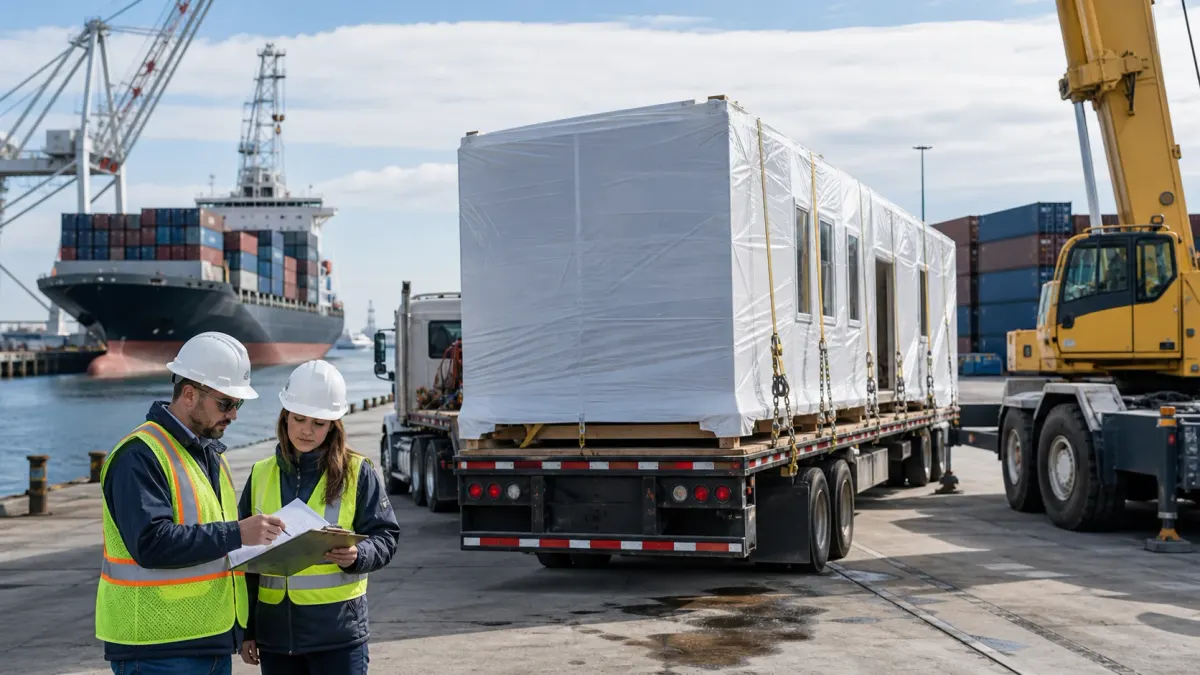
Two equal factory prices can lead to very different project costs
An international quotation may present a clear unit price and still leave the buyer without a usable budget. The price may stop at the factory gate, include export packing and port delivery, extend to ocean freight, or reach an inland destination. It may exclude customs entry, duties, port charges, storage, inland haulage, unloading, crane work, foundation, installation, utility connections, and local professional services.
The problem becomes more serious when the product description is vague. “Container house,” “modular unit,” “flat pack,” and “prefabricated building” can be commercial labels rather than complete customs descriptions. Classification depends on the actual goods and how they are presented at import.
Before comparing quotations, separate three questions: What are the goods? Who is responsible for each transport and customs task? Which costs are included in the project budget?
Start with three separate answers
Classification identifies how the described goods are treated under the applicable tariff system. Incoterms allocate defined delivery tasks, costs, and risks between seller and buyer. Landed-cost assumptions assemble the expected financial layers for the specific shipment and destination.
One answer cannot substitute for the other two. An Incoterm is not an HTS classification. A tariff code does not calculate unloading or installation. A landed-cost spreadsheet is not reliable if the product description or country-of-origin assumptions are wrong.
This article provides a scope framework, not customs, tax, or legal advice. Product-specific review should come from qualified customs and trade professionals.
Classification begins with an accurate description of the goods
A customs professional needs more than a marketing name. Useful information can include the product's intended use, materials, dimensions, level of completion, components included, how it is shipped, whether it is assembled before or after import, and the function it will perform.
The difference between an empty storage structure, a building module with integrated services, a kit of components, and an ISO freight container can be material. Photos and drawings may be necessary, but they should match the goods that will actually cross the border.
Country of origin also requires a factual analysis. It should not be assumed from the port of departure, seller address, or final assembly location alone. Materials and processing can matter, and different trade measures can apply to different facts.
The earlier these details are fixed, the less likely the project is to discover a customs assumption after production or shipment.
A customs ruling answers one factual description
US Customs and Border Protection ruling N347685, dated April 18, 2025, is a useful example of the limits of analogy. The ruling considered described flat-pack, container-style steel storage units from Turkey. CBP treated those specific goods as prefabricated buildings under the classification stated in the ruling.
The document also says the holding applies only to the factual situation and merchandise description identified in the request. If the facts change or the imported goods do not match the description, the conclusion should not simply be copied.
This is why a ruling can be informative without being a universal answer. A completed residential module, an unfinished steel frame, a storage unit, and a component shipment may not share the same facts. Buyers should not place a ruling number in a quotation as if it certifies every product in the same commercial category.
Tariff information has a date
Trade measures change. CBP's public knowledge article on steel duties is dated February 13, 2026 and itself states that the information is general and does not constitute reasonable care. Rates, product scopes, exclusions, executive actions, country treatment, and reporting requirements can change after an article is written.
For that reason, an evergreen planning article should not build its conclusion around one percentage. A quotation should state the date of its tariff assumption, the described goods, origin assumption, relevant classification analysis, and the party responsible for final entry decisions.
Before shipment, the buyer or importer of record should obtain a current review. A website article or old quotation cannot replace that step.
Incoterms allocate responsibilities, not every project cost
Incoterms are useful because they establish defined responsibilities for delivery, cost, and risk at particular points. They do not automatically describe customs classification, tax treatment, local port practice, unloading method, site access, installation, or the complete commercial contract.
A three-letter term should therefore be accompanied by a named place and the applicable Incoterms edition. The quotation should also explain the practical boundary in plain language. Who books the main transport? Who provides export clearance? Who is importer of record? Who pays destination charges? Who arranges inland delivery? At which point does risk transfer?
For modules, the practical detail matters because oversize cargo, flat-rack or containerized shipping, port handling, road permits, escort requirements, and site unloading can vary.
Build the landed-cost layers from factory to prepared site
A useful landed-cost model separates at least:
- product and selected options;
- drawings, engineering, testing, and documentation included in the supply;
- factory packing and loading;
- inland origin transport and export handling;
- ocean or cross-border transport;
- insurance where applicable;
- destination port, terminal, brokerage, and inspection charges;
- duties, taxes, trade measures, and fees based on current professional advice;
- inland destination transport and permits;
- storage or delay exposure;
- unloading, crane, lifting gear, and temporary works;
- foundation, utilities, site installation, testing, and local approvals.
Not every project uses every layer. The purpose is to make exclusions visible. A blank line is better than an assumed zero.
Use an assumption sheet beside every quotation
The quotation review should record the product description, origin, shipment format, quantity, dimensions, weights, Incoterm and named place, estimated ship date, destination, importer of record, classification owner, tariff review date, transport owner, unloading method, site-access limits, and excluded work.
It should also identify which values are supplier commitments, third-party estimates, allowances, or unknowns. That distinction prevents an early budget from becoming an unintended fixed promise.
When two suppliers are compared using the same assumption sheet, a higher factory price may turn out to include more documentation or delivery scope. A lower price may still be the right choice, but the decision becomes transparent.
Know when professional review is necessary
Product-specific classification, origin, valuation, trade measures, and entry requirements belong with a licensed customs broker or other qualified trade professional. Complex or high- value shipments may also require trade counsel, tax advice, logistics engineering, and local transport review.
The right time for that review is before the commercial and technical scope is frozen, not when the cargo is approaching the port.
International modular procurement becomes more predictable when classification, shipping responsibility, and site completion are treated as connected but separate workstreams. The goal is not to predict every charge months in advance. It is to expose who owns each answer.
Sources
CBP steel tariff knowledge article, dated February 13, 2026 and CBP ruling N347685, April 18, 2025